Quantum circuits
The module Circuits provides a way to construct and simulate circuits. Initialise an empty circuit with Circuit(n) where n is the number of qubits. Then, add gates to the circuit with push!(circuit, gate, qubits...) where gate is a string representing the gate and qubits are the qubits the gate acts on. For example, a CNOT gate with control qubit 1 and target qubit 2 is added to the circuit c with push!(c, "CNOT", 1, 2). Depolarizing noise can be added to the circuit with push!(c, "Noise"). The noise amplitude can be set with c.noise_amplitude=p.
Lets construct a CCX gate (Toffoli gate) out of CNOT and single qubit gates.
using PauliStrings
using PauliStrings.Circuits

function noisy_toffoli()
    c = Circuit(3)
    push!(c, "H", 3)
    push!(c, "CNOT", 2, 3); push!(c, "Noise")
    push!(c, "Tdg", 3)
    push!(c, "CNOT", 1, 3); push!(c, "Noise")
    push!(c, "T", 3)
    push!(c, "CNOT", 2, 3); push!(c, "Noise")
    push!(c, "Tdg", 3)
    push!(c, "CNOT", 1, 3); push!(c, "Noise")
    push!(c, "T", 2)
    push!(c, "T", 3)
    push!(c, "CNOT", 1, 2); push!(c, "Noise")
    push!(c, "H", 3)
    push!(c, "T", 1)
    push!(c, "Tdg", 2)
    push!(c, "CNOT", 1, 2); push!(c, "Noise")
    return c
end
noisy_toffoli (generic function with 1 method)We can plot the circuit using QuantumCircuitDraw.jl:
using QuantumCircuitDraw
c = noisy_toffoli()
paulistrings_plot(c)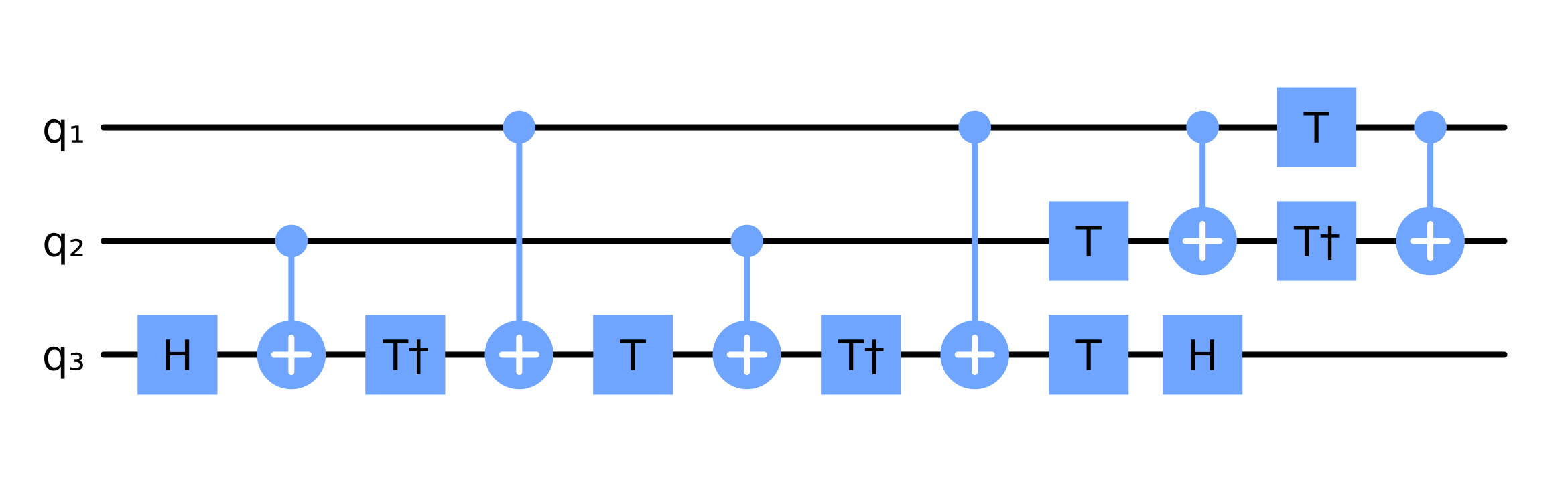
The circuit can be compiled to a unitary matrix with compile(c). Before compiling, set c.noise_amplitude to the desired noise amplitude and c.max_strings to the number of strings to keep at each step. Compile will multiply the gates in the circuit from left to right, apply the noise using add_noise and trim the operator at each step using trim.
Lets check our Toffoli gate against the built-in CCX gate in Circuits:
using PauliStrings.Circuits
using LinearAlgebra: norm
c = noisy_toffoli()
c.noise_amplitude = 0
U1 = compile(c)
U2 = CCXGate(3,1,2,3)
println(norm(U1-U2))1.2857753552864526e-15We can also compute expectation values of states in the computational basis with expect(c, state_out) and expect(c, state_in, state_out) . Let's compute the expectation values of the output states of the Toffoli gate when the input state is $|111\rangle$:
in_state = "111"
out_states = ["000", "001", "010", "011", "100", "101", "110", "111"]
p = [real(expect(c, in_state, out_state)) for out_state in out_states]
using Plots
bar(out_states, p, legend=false, xlabel="out state", ylabel="<out|U|in>")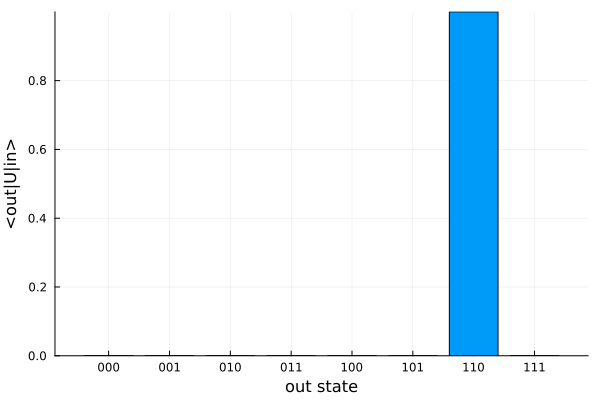
Same as above but seting the noise amplitude to 0.05:
c.noise_amplitude = 0.05
p = [real(expect(c, in_state, out_state)) for out_state in out_states]
bar(out_states, p, legend=false, xlabel="out state", ylabel="<out|U|in>")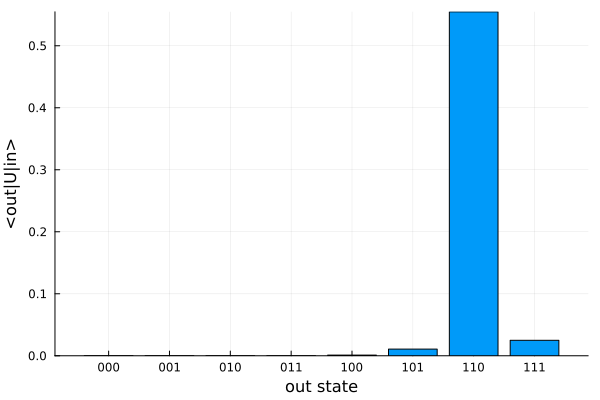
Importing OpenQASM circuits
OpenQASM is a standard text format for quantum circuits, so supporting it lets you pull circuits straight from benchmark suites like QASMBench. Load OpenQASM 2.0 into a Circuit with parse_qasm (from a string) or load_qasm (from a file). This wraps OpenQASM.jl for the parsing, so it becomes available once you also load that package.
The common qelib1.inc gates are mapped onto the existing Circuit gates. Multiple qreg declarations are concatenated into a single register in declaration order, and measure/barrier statements are ignored so the imported circuit is a pure unitary.
Here we load the two-qubit Deutsch circuit from QASMBench and run it like any other Circuit:
using PauliStrings
using PauliStrings.Circuits
using OpenQASM

source = """
OPENQASM 2.0;
include "qelib1.inc";
qreg q[2];
creg c[2];
x q[1];
h q[0];
h q[1];
cx q[0],q[1];
h q[0];
measure q[0] -> c[0];
measure q[1] -> c[1];
"""

c = parse_qasm(source)
println(c.gates)
Tuple{String, Vector{Int64}, Vector{Real}}[("X", [2], []), ("H", [1], []), ("H", [2], []), ("CNOT", [1, 2], []), ("H", [1], [])]The result is an ordinary Circuit, so compile, expect and the rest work as usual:
expect(c, "00", "11")-0.7071067811865474 + 0.0im